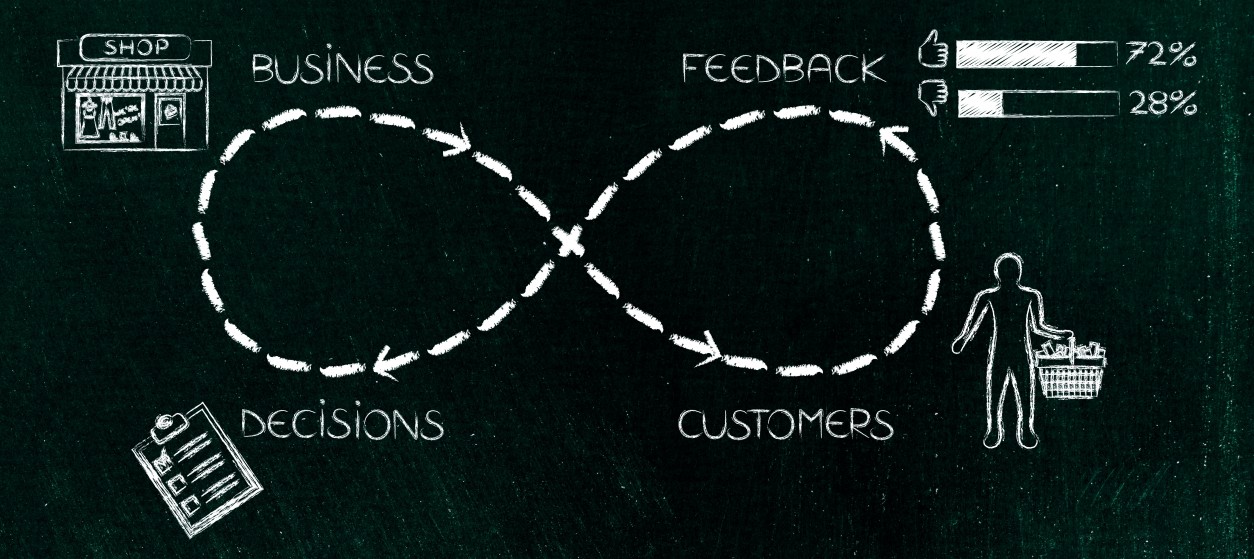
The concept of feedback loops is currently turning modern Customer Relationship Management Systems (CRMs) from static contact databases into control rooms for data-driven product decisions. In the scope of these loops, every interaction becomes a signal that reshapes who you target, what you build, and how you go to market. Instead of treating campaigns as one-way pushes down a funnel, leading teams are currently wiring CRMs into continuous feedback loops that connect customer insights, product usage, and revenue signals. Nevertheless, to implement and fully leveraging feedback loops in CRMs, marketing managers and Chief Information Officers (CIOs) had better understand the origins, the metrics and the functional characteristics of such feedback loops approaches.
From funnels to feedback loops
For several decades, CRM strategies have been dominated by the popular funnel metaphor, which consists of the following parts and flows:
· At the top, you pour in leads from ads, events, and inbound.
· In the middle, you qualify and nurture them.
· At the bottom, you close the “best-fit” and most profitable customers.
This model is useful for forecasting and managing sales capacity. However, it is mainly optimized for conversion, not for learning. Specifically, it treats the customer journey as a one-way flow, where data is mainly used to improve targeting and win rates. Unfortunately, funnels do not systematically reposition the product or reshape the value proposition for different segments. In contrast, a feedback-loop mindset assumes that every stage of the journey is an experiment whose results should feed back into product strategy. Instead of asking “How do we push more leads to the bottom of the funnel?”, teams had better ask “What did this cycle teach us about customer needs, product experience, and economics, and how should we adjust our bets?”.
The Sources of Rich Data: How CRMs integrate touchpoints
The operation of both funnels and feedback loops is grounded on the availability of customer data. Modern CRMs sit on top of unified data platforms and APIs, which ingest signals from a wide range of digital and physical touchpoints. Some of the most typical integrations include:
· Marketing and web, including ad platforms, web analytics, landing pages, content downloads, and information email engagement (e.g., opens, clicks, replies).
· Product and telemetry, including logins, feature usage, time-to-value, error rates, device or app telemetry, and in-product Net Promoter Scores (NPS) prompts.
· Commercial and service, including quotes, orders, invoices, tickets, Service Level Agreements (SLAs), upsell conversations, and renewal outcomes.
· External and social, including social listening, review platforms, community interactions, and third-party intent data.
Unified data platforms and real-time integration tools consolidate these sources towards improving quality and consistency across the organization and making them consumable by CRM workflows. Cloud-based architectures, distributed processing frameworks, and APIs allow CRMs to stream and process high-volume interaction data at scale, which turns CRMS into hubs for customer insights rather than simple systems that record data. When this integration is done well, the CRM profile for a single account looks less like a static form and more like a living timeline, which tests campaigns, consumes content, tries product features, and raises tickets. This gives commercial and product teams a shared, longitudinal view of the customer, which is essential for data-driven product decisions.
Limitations of the traditional funnel
Even with rich data, funnel-centric operating models have three systemic limitations:
· The voice of the customer is underused. This is because most funnels focus on volumes and conversion rates, while ignoring qualitative signals and nuanced behavior (e.g., which features drive stickiness, which workflows cause friction). Surveys, support conversations, and community feedback become sporadic inputs rather than structured, continuous signals that improve roadmaps and messaging decisions.
· Static assumptions about “ideal customers”. Traditional Ideal Customer Profile (ICP) definitions are often updated annually and based on firmographics and basic profitability, not on detailed patterns of adoption,
expansion, and long-term value. As a result, teams keep targeting segments that look profitable on paper but systematically churn because product–market fit is weaker than anticipated.
· One-way optimization. Campaign experiments typically optimize creative and channels while leaving core packaging, pricing, and feature strategy untouched. The funnel ends at “closed-won”, even though post-sale behavior (activation, support tickets, unit economics) often reveals where the product and targeting are misaligned.
In a world where user behavior, telemetry, and financial metrics are observable almost in real time, this static, one-way model leads to CRM under performance. It silently maximizes output (e.g., deals) rather than outcomes in the form of sustained adoption, satisfaction, and profitability by segment.
CRMs as control rooms for strategy
Transforming CRM into a control room where feedback is continually accounted for in order to refine the offerings to the customer is largely about wiring closed-loop feedback between customer interactions, product evolution, and go-to-market execution. In practice, this comprises the following processes:
· Closed-loop measurement across the lifecycle: Outcome-driven roadmaps connect customer metrics (e.g., activation, adoption, retention, NPS), product metrics (e.g., performance, feature usage, error rates), and financial metrics (e.g., Customer Lifetime Value (LTV), cost-to-serve) at the account level. In this context, spikes in churn within a micro-segment (i.e., customers abandoning the service) or failure patterns for a specific feature can trigger investigation and radical roadmap adjustments rather than casual efforts for better targeting.
· Hypothesis-driven product and GTM experiments: Features, bundles, and offers are treated as hypotheses. For instance, a CRM with feedback loops may test an assumption like: “This new onboarding flow should improve first-week activation for mid-sized teams in manufacturing.”. Hence, the CRM tracks which customers see which versions, their subsequent product behavior, and their commercial outcomes. These are then considered by product and marketing professionals in order to double down on what works and avoid what does not.
· Dynamic segmentation and targeting: Instead of static buyer personas, segments evolve as the system learns which combinations of customer signals (e.g., behavior, product usage, economics) correlate with positive outcomes. Marketing and sales playbooks are then automatically adjusted to these insights towards improving targeting continuously rather than based on an annual planning lifecycle.
· Continuous customer insights into the roadmap: Feedback from tickets, interviews, surveys, and telemetry is aggregated and surfaced as thematic insights (e.g., “there are latency issues for mobile users”). Roadmap themes are then prioritized based on measurable impact on satisfaction, retention, and economic outcomes. In essence, this closes the loop between customer voice and product investments.
Overall, in this model, data-driven product decisions emerge from a shared instrumentation layer across CRM, product analytics, and financial systems, rather than from isolated dashboards within each function. The CRM becomes the orchestration layer where these perspectives converge, and drive coordinated action which is likely to improve outcomes.
Technology enablers of CRM feedback loops
Nowadays, several technology building blocks make this feedback-loop approach feasible and scalable in practice:
· Unified data platforms and integration tools: Centralized data platforms consolidate structured and unstructured data from CRM, marketing, product, and finance. Thus, they enable a single source of truth for customer interactions. API-first architectures and real-time integration tools ensure that CRMs always work with fresh data from external systems and internal services.
· Cloud and scalable processing: Cloud infrastructure and distributed processing frameworks provide elastic compute and storage for high-volume interaction data, including clickstreams and telemetry. This elasticity is essential for running complex analytics and machine learning models on top of CRM data in a scalable way and without high infrastructure costs.
· Advanced analytics and Machine Learning: ML models detect patterns about how segments adopt features, how specific workflows drive churn, and which combinations of signals can best predict expansion or risk. Predictive analytics and recommendation models can then inform prioritization, flag at-risk accounts, and integrate next-best-actions directly inside CRM workflows. The latter reinforce the effectiveness of feedback loops.
· In-product instrumentation and telemetry: In recent years it is possible to implement fine-grained instrumentation of digital products (e.g., events, performance metrics, sensor data) towards creating a live feed about how the product behaves in the real world. This telemetry information turns each account into a “sensor” for product strategy, which reveals where and how architecture, User Experience (UX), or packaging must adapt.
· Automation and orchestration engines: Workflow engines in and around the CRM can trigger automated actions when certain signals appear. Prominent examples of such signals are decrease in usage, spike in support interactions, and positive feedback in a niche segment. This automation makes it feasible to operationalize feedback loops at scale instead of relying on manual analysis and ad-hoc interventions.
· Governance and data-driven culture: Clear governance frameworks are essential in order to ensure that data is trusted, secure, and used ethically. At the same time, proper governance is a tool for leadership to promote a culture of outcome-based and data-driven decisions. When product, marketing, and sales share common metrics and trust the same customer insights, the CRM can truly operate as the control room of product and go-to-market strategy.
Overall, feedback loops instead of funnels is not just a slogan but a practical operating model. In the next year, CRMs will continue to evolve from static pipelines to adaptive control rooms where customer insights, telemetry, and financial data flow continuously into better-targeted, more relevant, and more resilient product strategies.