During the first couple of years following the emergence of ChatGPT, generative AI in the enterprise largely meant one thing, namely LLM?based chatbots embedded in portals, enterprise systems (e.g., Customer Relationship Management (CRM)) and intranets. This is gradually challenging during the last year, where agentic AI is looming as a very effective technology for automating enterprise applications. Specifically, the conversation is rapidly shifting toward autonomous, task?specific micro-AI agents that can operate inside workflows, talk to APIs, and make decisions without a human in the loop for every step.
From Chatbots to Autonomous Agents
First?generation enterprise deployments focused on conversational assistants that could answer Frequently Asked Questions (FAQs), summarize documents, or draft content on demand. These tools were operating on top of existing processes and relied on humans to interpret outputs, make decisions, and perform actions in back?office systems. Nowadays, the next wave of AI-based deployments is emerging, which is more about agents rather than assistants. Instead of passively responding to prompts, an agent can plan a sequence of actions, call tools or services, and monitor progress until a goal is reached. In this context, micro AI agents are small, narrowly scoped entities, which are responsible for well?defined tasks such as classifying incoming emails and routing them to specific recipients, extracting invoice data and pushing it to Enterprise Resource Planning (ERP) systems or even generating a first draft of system requirements from a backlog of customer tickets. This architectural shift moves GenAI from the browser tab to the process layer of the enterprise. It is augmenting knowledge workers, while at the same time becoming part of the execution fabric of AI-based workflow optimization and intelligent automation.
Micro AI Agents: A Good Match for Enterprise Workflows
Most enterprises rarely need a single monolithic AI brain. Rather they need a mesh of small, composable agents that can be orchestrated just like microservices. This is where micro AI agents are preferred due to their following characteristics:
· Specialized: Each agent is optimized for a narrow context (e.g., compliance checks, Service Level Agreement (SLA) validation, Know Your Customer (KYC) data extraction), which reduces reasoning ambiguity and improves reliability.
· Governable: Most agents have a constrained scope, which makes it easier to define inputs, outputs, guardrails, and monitoring KPIs aligned with IT governance and risk frameworks.
· Reusable: Agents can be reused across contexts and applications. For instance, an agent that validates invoice completeness can be reused in finance, procurement, and vendor onboarding flows with very few changes.
· Automation Integration: Many agents can be directly plugged into existing automation stacks. They can sit on top of Robotic Process Automation (RPA) and/or workflow engines, while adding flexible reasoning in use cases where rules and scripts reach their limits.
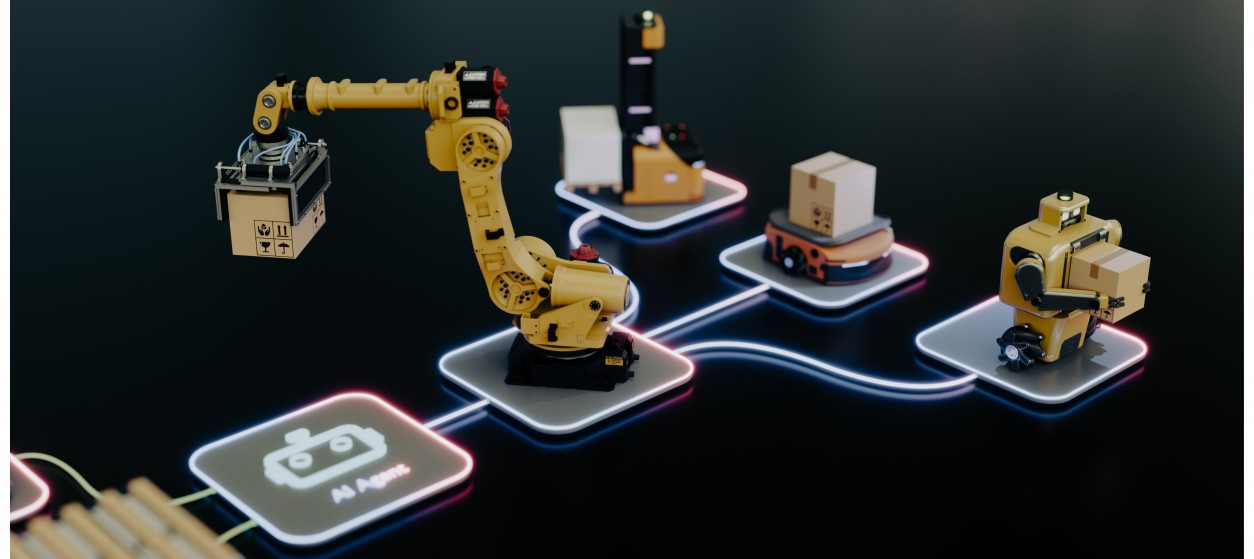
Overall, agents enable the development of a layered model for AI-based intelligent automation. In this layered model, RPA handles deterministic clicking and data movement, workflow engines orchestrate activities and micro AI agents provide cognitive decisions, classification, and content generation inside specific steps.
Concrete Examples of Enterprise Use Cases
Nowadays, micro AI agents can be deployed across front?, middle?, and back?office domains. Some of the most prominent examples include:
· Customer support: Customer support agents are typically triage and routing agents that read incoming emails or chat messages, classify intent, detect urgency, and route to the right queue or self?service flow. Moreover, customer support use cases can benefit from resolution agents that search knowledge bases and generate draft responses, which can be auto?sent (e.g., for low?risk queries) or queued for human review (e.g., in complex cases).
· Finance and procurement: In the finance and accounting domains, there are invoice processing agents that can extract line items, VAT numbers, and payment terms from documents (e.g., PDFs), while at the same time pushing them to ERP or accounting systems. Likewise, there are spend classification agents that map transactions to cost centers and categories in order to feed relevant analytics and compliance dashboards.
· Human Resources (HR) and internal operations: HR teams can benefit from policy assistant agents that answer employee questions about leave, travel, or benefits based on up?to?date policies. At the same time, there are candidate screening agents that summarize CVs, match them against job descriptions, and produce structured shortlists for recruiters.
· IT and Product Development: Software teams and software development processes leverage requirements distillation agents that cluster customer feedback and support tickets into themes and candidate backlog items. There are also log?triage agents that summarize incidents, correlate them with known problems, and propose remediation steps for Development and Operation (DevOps) teams.
All of the above use cases achieve workflow optimization based on the embedding of micro AI agents directly into event?driven processes. This obviates the need for interpreting outputs based on human involvement, which boosts the scalability and automation of enterprise processes.
What Can Be Automated and What Cannot
Despite the power of agents, not everything in an enterprise workflow is ready for a “no human in the loop” automation. Specifically, tasks that can often be automated end?to?end include:
· High?volume, low?risk document processing, including for example processing of invoices, receipts, and standard contracts based on pre?approved templates.
· Data enrichment and normalization for CRM, Master Data Management (MDM) and analytics systems, where errors are detectable downstream based on well-defined validation rules.
· First?line customer interactions involving status checks, password resets, appointment scheduling, and basic troubleshooting.
· Routine reporting, Key Performance Indicator (KPI) dashboards, and status summaries, which can be synthesized from operational data.
On the other hand, less structured and more complex tasks that still need humans in or above the loop include:
· Strategic decisions with non?quantifiable trade?offs, such as market entry, M&A, or major product pivots.
· Edge?case handling in regulated areas like healthcare, finance, or public administration, where liability and ethics are critical.
· Nuanced relationship management (e.g., complex sales, high?stakes negotiations, sensitive HR cases), where context goes far beyond available data.
In practice, the most effective deployments combine autonomous execution for known, repetitive, bounded?risk activities with human oversight, sampling, and exception handling. Likewise, full “no?human?in?the?loop” is viable where the space of possible outcomes is well understood, and robust guardrails exist across data, access, and actions.
Well?Defined Processes Matter
Micro AI agents do not magically fix broken or poorly specified processes. On the contrary, they make process weaknesses painfully visible. For intelligent automation with AI to work at scale, the underlying workflows must be explicitly defined based on:
· Clear boundaries: Each agent needs a crisp contract in terms of what it receives, what it produces, what tools it may call, and what it is never allowed to do.
· Canonical data models: Without consistent schemas and semantics across systems, agents will propagate inconsistencies rather than resolving them.
· Embedded controls: Validation steps, exception routes, and audit trails must be designed early on to ensure that autonomous actions remain observable and reversible.
The enterprise shift towards micro agents mirrors the transition from monolithic applications to microservices and Cloud?native architectures. In particular, the organizations that benefited most were those that invested in API design, observability, and DevOps practices, not those that simply split a big app into smaller pieces. The same applies to the shift from generic LLM chatbots to micro AI agents. The value comes from disciplined design of processes, interfaces, and governance, not from the use of the model alone.
For CIOs, business leaders, and R&D teams, the opportunity is clear: To move from experimenting with isolated GenAI pilots to designing ecosystems of focused agents that live inside real enterprise workflows. Enterprises that do this well, can unlock durable workflow optimization, higher?quality outputs, and a new layer of AI-based intelligent automation that clearly delivers more benefits than conventional chatbots.